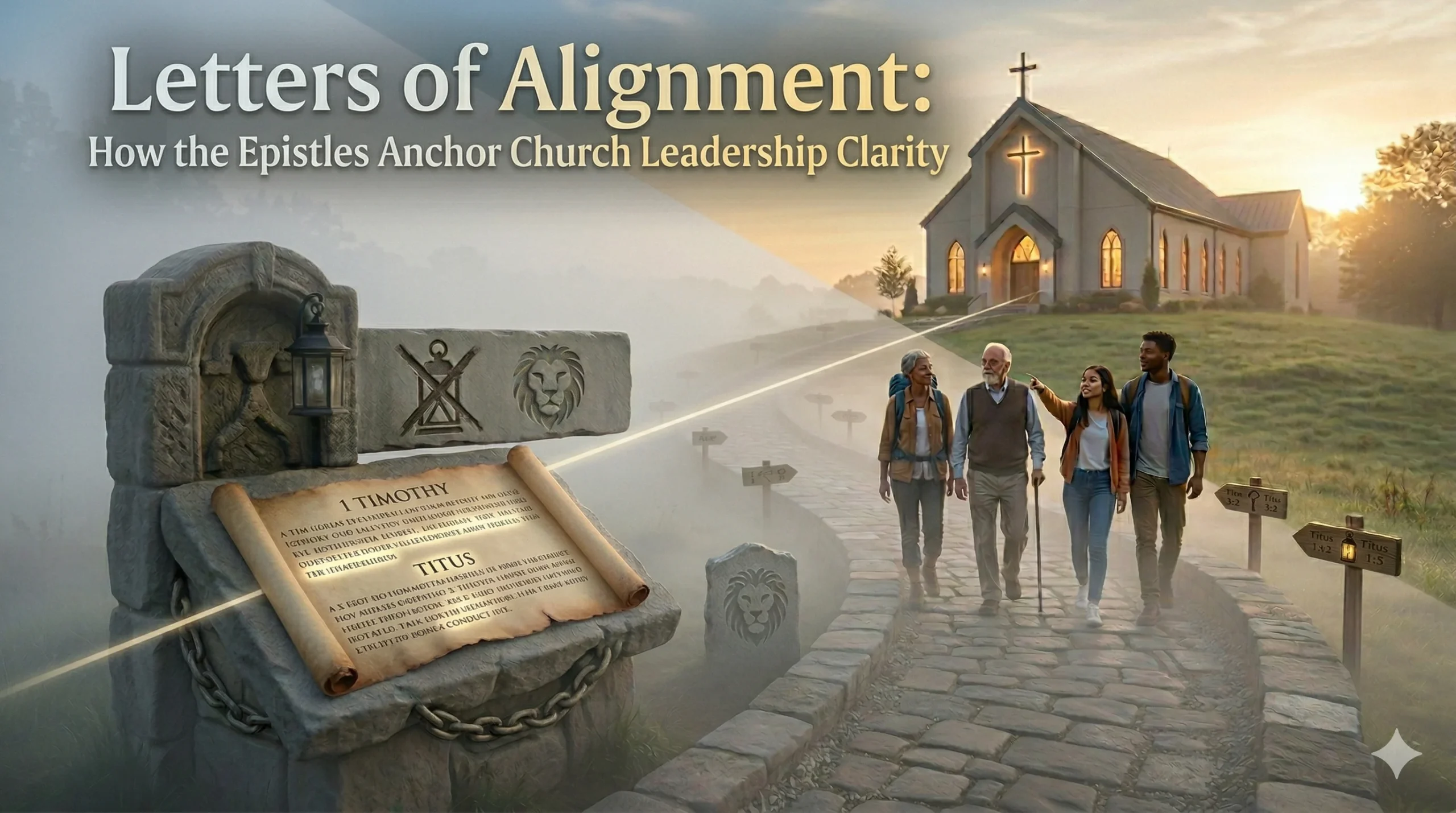
Letters of Alignment: How the Epistles Anchor Church Leadership Clarity


Letters of Alignment: How the Epistles Anchor Church Leadership Clarity

April 6, 2026
Letters of Alignment: How the Epistles Anchor Church Leadership Clarity

Church Leadership Clarity That Builds and Aligns

By the time we reach the Epistles in the New Testament, the Church has been birthed, the Spirit has moved in power, and the mission has launched. But these Spirit-inspired letters don’t just offer theology, they offer church leadership clarity, helping congregations stay grounded, aligned, and fruitful.

The mission of Jesus is complete—“It is finished”—and yet it continues. Why? Because He entrusted its spread to people. And wherever people lead, mission drifts. Vision is blurry. Behavior fractures. Assumptions creep in. Opinions pull us off course. That’s why church leadership clarity is not just helpful, it’s essential. The Epistles exist to hold the Church steady, to realign her again and again with the truth, so that the mission doesn’t stall under the weight of confusion.

That’s why the Epistles exist.

If the Gospels call us to follow Jesus, and Acts shows what that looks like in motion, the Epistles are the Spirit’s gift to keep the Church clear and aligned on what matters most.

The Epistles are letters of clarity, pointed, personal, Spirit-breathed messages that:

  • Anchor us in sound doctrine
  • Clarify the Gospel amid cultural confusion
  • Align belief and behavior
  • Re-center identity in Christ
  • Call leaders and followers back to mission

And in doing so, they remind us that clarity is a ministry of love, a commitment to truth that protects the Church, nourishes her growth, and strengthens her witness.

When Church Leadership Clarity Is Missing

Every Epistle is written for a reason. And often, that reason is misalignment.

  • The Corinthians were divided, proud, and misusing spiritual gifts.
  • The Galatians were distorting grace, adding law to the Gospel.
  • The Thessalonians were confused about Christ’s return and discouraged by persecution.
  • The Colossians were tempted to add mysticism to Christ.

What did Paul (and others) offer in response?

Clarity.

Not condemnation. Not vague encouragement. Not more programs or meetings. But, church leadership clarity. The result?

Clarity of:

  • Identity
  • Purpose
  • Doctrine
  • Conduct
  • Hope

Five Ways the Epistles Anchor Church Leadership Clarity

Here’s how the Epistles serve as a blueprint for church leadership clarity:

1. They Clarify Identity (Ephesians 1–2, Romans 6)

We are chosen, redeemed, seated with Christ, and dead to sin. Our clarity as leaders starts with remembering who we are.

2. They Define the Mission (2 Corinthians 5:17–21, Philippians 1:27)

We are ambassadors of reconciliation. Living lives worthy of the Gospel. If we forget the mission, we drift into self-preservation or cultural conformity.

3. They Align Belief with Behavior (Titus 2:11–14, James 2:14–26)

True clarity transforms. The Epistles call for congruence between what we say and how we live. Integrity is clarity lived out.

4. They Equip the Saints for Ministry (Ephesians 4:11–16, Romans 12:4–8)

Leadership clarity isn’t just for the pulpit; it’s for the people. The Epistles cast a vision for every member engaged in mission.

5. They Sustain Hope in Suffering (Romans 8, 1 Peter 1:3–9, 2 Corinthians 4:16–18)

When pressure rises and clarity dims, the Epistles anchor us in eternal hope. The mission is sustained by hope that isn’t circumstantial. And, the vision is pursued with joy and resilience.

Why This Matters in Your Church

Too many churches operate with inherited language and vague assumptions:

  • “We’re here to make disciples.”
  • “We value community.”
  • “We’re Gospel-centered.”

But what do those words mean? And how do they shape your strategy, structure, language, and metrics?

Without clarity:

  • Your people get confused.
  • Your staff team splinters.
  • Your programs multiply but your fruit shrinks.

And most painfully:

  • Your mission stalls.

But the Epistles show us that alignment is possible and necessary.

When a church defines:

  • What kind of disciples they’re forming
  • What outcomes matter most
  • How every member contributes

…momentum builds.

Anchored in the Word, Shaped by the Spirit

Clarity isn’t about control; it’s actually about creativity. When leaders are clear, they don’t restrict innovation; they unleash it. The Epistles aren’t rigid rulebooks. They’re relational letters, shaped by context and written in love, offering grounded guidance for dynamic, Spirit-led leadership.

Take notice of how these timely and passionate letters point us toward something essential:

Faithful leadership demands courageous clarity.

We don’t serve our churches well by guessing, assuming, or avoiding the hard conversations. We serve them best by offering mission, values, strategy, outcomes, and vision that are:

  • Biblical
  • Contextual
  • Courageous
  • Lived

So, when clarity flows from the Gospel, it bears Gospel fruit.

Want to Start Clarifying What Matters Most?

Don’t wait for crisis to force clarity.

Use the Vision Clarity Audit Worksheet to start an honest, team-based assessment of where clarity is strong and where it needs strengthening.

📄 Click here to access the free tool

With clarity and care,
Jeff Meyer

P.S. I’d love to hear how this lands with you.
Here are two simple ways to share your thoughts or story:

Leave a Voice Message


Record my Message

Send a Quick Note


Share My Story

Whether it’s a reflection, a question, or just a word of encouragement, I read and listen to every message. Thanks for being part of this clarity journey.

Looking for practical steps to walk this out in your church?

Don’t miss the full series: The Best Vision Clarity Process for Churches
From listening and naming the horizon to strategic milestones and 90-day sprints, this roadmap helps teams put Christ-shaped vision into motion—together.

Tags : Vision Clarity Pillars Share This :

Facebook-f


Twitter


Tiktok


Linkedin-in


Instagram

Related Post

Church Leadership Clarity: What the Book of Acts Reveals About Real Growth

Church Leadership Clarity: What the Book of Acts Reveals About Real Growth

April 6, 2026

Church Leadership Clarity: What the Book of Acts Reveals About Real Growth

Follow Jesus with Clarity Series
(2 out of 5)

Church Leadership Clarity That Changes Lives

Let’s face it. The grind of church leadership is real. That’s why this moment is ripe for rediscovering church leadership clarity.

Most pastors I know aren’t sitting around dreaming of a busier calendar. They’re wondering how to make what they’re already doing more meaningful. They’re asking:

  • Why does it feel like we’re always doing, but not moving?
  • Why are our people showing up but not growing?
  • Why does “disciple-making” feel like a buzzword instead of a shared journey?

If you’re nodding along, you’re not alone.

And it’s not because you lack passion. It’s because church leadership clarity is missing.

When churches lack church leadership clarity on what kind of disciples they’re forming and what growth in Jesus looks like, the mission stalls, burnout rises, and even your most dedicated people begin to drift.

But the book of Acts gives us a vision of a different kind of Church. One marked by movement. A church where you could see the growth. And that kind of church leadership clarity is not man-made, it’s Spirit-inspired.

That’s why church leadership clarity and the Book of Acts are not optional. They’re essential.

The Pain of Clarity Gaps When Church Leadership Clarity Isn’t Fully Formed

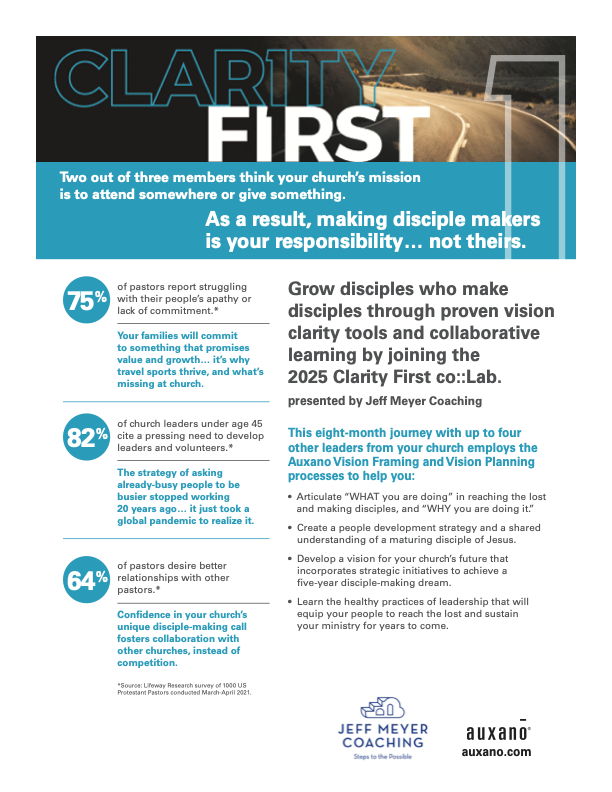
Earlier this week, I shared this one-pager in a social media post

And I added this quote:

“The best investment I’ve made in ministry? Vision clarity. Hands down.”

Micah, a gifted leader and pastor, replied:

“Wait?! People aren’t sitting around asking to be busier… Love the connection to the value proposition of youth sports and how the church can learn from it!”

He nailed it.

Families rearrange their lives for sports because there’s a clear value proposition:

  • Development
  • Belonging
  • Visible growth

What if the Church could reclaim that same compelling clarity?

What if we could show people what spiritual growth looks like and why it matters?

When churches invest in church leadership clarity, and define growth clearly and biblically, people are energized. They join in. When churches don’t invest in church leadership clarity, people either settle into passive attendance or disengage altogether.

What Does Growth in Jesus Actually Look Like?

In the book of Acts, we see a vibrant picture of transformed people. And it wasn’t theoretical. It was measurable. Tangible. Repeatable.

Here are 5 biblical measures we see in Acts:

  1. Give Sacrificially (Acts 2:44–45, Acts 4:32–37)
  2. Speak Boldly (Acts 4:31, Acts 28:31)
  3. Cross Boundaries (Acts 10, Acts 13)
  4. Develop Leaders (Acts 6:1–7, Acts 20:28)
  5. Experience Transformation (Acts 19:18–20)

These measures are not abstract. They’re real-life evidence that the Gospel is taking root. And measures, or sometimes we call them outcomes, are essential for churches that want to move from maintenance to mission.

Imagine If…

Imagine if you and your leaders had invested in church leadership clarity. Imagine if your church was so clear on your own, unique, memorable outcomes that your people were talking about them, pursuing them, trusting in the Spirit of the Living God to develop these outcomes as they followed Jesus.

The promise to their family, friends, and neighbors is that they could experience these outcomes too.

Wow! What a gift for the neighborhood, community, and world. Church leadership clarity spreads because it makes it easier to grasp, describe, and share.

Now that’s something to invest in as a leader, right?

So What? Why These Measures Matter for Real People

If we can’t show how this kind of clarity changes lives, no one will care. And they shouldn’t.

Because no one wants to give their life to busywork. But people will give their life to transformation.

Let’s go deeper:

🔶 Give Sacrificially

  • Financial fear loosens its grip.
  • Families see their money as joy-fueled mission, not stress.
  • Children learn generosity by example.

“I used to live paycheck to paycheck, hoarding what I could. Now I see our home and our money as part of God’s mission.”

🔶 Speak Boldly

  • People stop hiding.
  • They pray out loud.
  • They speak truth in love and stand for justice.

“I used to shrink back when faith came up. Now I can speak with calm confidence because I know who I am.”

🔶 Cross Boundaries

  • Racial, economic, and political divides shrink.
  • “Outreach” becomes relationships, not projects.

“I used to fear people who were different from me. Now some of them are my closest friends in Christ.”

🔶 Develop Leaders

  • Burnout decreases.
  • Young adults step up.
  • Legacy leaders find joy in mentoring.

“I never saw myself as a leader until someone gave me a shot.”

🔶 Experience Transformation

  • Addictions break.
  • Marriages heal.
  • Confession becomes normal.

“We burned the idols in our home—literally and figuratively. That night, we slept in peace for the first time in years.”

Real Clarity Creates Real Change

This isn’t about programming. It’s about people.

When churches anchor their vision in these biblical outcomes:

  • People feel the shift.
  • People stay.
  • People invite others in.

Because clarity fuels movement.

Not church leadership clarity for clarity’s sake. Clarity that changes lives.

And it all starts by asking:

“When are we successful?”

If your only answer is “When people show up,” you’re missing the invitation Jesus offers—to form disciples who reflect Him in every part of their lives.

So let’s reclaim your brilliantly clear outcomes. Let’s define growth not as attending or busyness, but as becoming.

Clarity begins here.

Don’t Just Copy Church Leadership Clarity—Discover It!

It might be tempting to take these five biblical measures from Acts and paste them onto your website or sermon series and call it church leadership clarity.

But true transformation doesn’t come from borrowing someone else’s language.

It comes from the slow, faithful work of discerning what growth in Jesus looks like in your specific context with your people and your calling.

There’s an old Chinese proverb:

“The way is made by walking it.”

And that’s exactly what we see in the book of Acts. The early church didn’t start with a clarity framework. They started by following Jesus and being led by the Holy Spirit. Along the way, fruit emerged. Patterns formed. Language crystallized. Lives changed. Measures became visible.

Not because they copied someone else’s outcomes.
But because they were willing to follow where the Spirit led—in real time, with real people.

That’s what makes vision clarity real.
That’s what makes it transformational.

And that’s why your church needs to walk this road yourselves.

Want to Start Naming What Growth Looks Like in Your Context?

📄 Download the Vision Clarity Audit Worksheet to get started: Click here to access

Or join the Vision Co:Lab this Fall and start building a clarity framework with other pastors and leaders, that’s grounded in Scripture and tailored to your context.

💬 DM me to learn more or Schedule a Vision Conversation

With clarity and care,
Jeff

Looking for practical steps to walk this out in your church?

Don’t miss the full series: The Best Vision Clarity Process for Churches
From listening and naming the horizon to strategic milestones and 90-day sprints, this roadmap helps teams put Christ-shaped vision into motion—together.

Tags : Vision Clarity Pillars Share This :

Facebook-f


Twitter


Tiktok


Linkedin-in


Instagram

Related Post

Come, Follow Me: How to Follow Jesus with Clarity and Courage

Come, Follow Me: How to Follow Jesus with Clarity and Courage

April 6, 2026

Come, Follow Me: How to Follow Jesus with Clarity and Courage

Follow Jesus with Clarity Series | Post 1 of 5

“Come, follow me…”

— Jesus (Matthew 4:19)

Jesus’ very first words to His disciples weren’t a call to agreement. They were a call to movement.
Before mission statements. Before sermons. Before structures.
There was a clear and simple invitation: “Follow Me.” And that’s where true clarity begins, not with ideas, but with obedience. To follow Jesus with clarity means responding to His voice with faithful steps, not just theological nods. It’s about direction, not just devotion.

This is the function of clarity:
To awaken action.
To prompt movement.
To interrupt life as usual and begin a new direction.

1. Clarity Begins With a Call: Follow Jesus with Clarity (Function)

Jesus’ call wasn’t vague—it was directional.
It disrupted. It demanded movement.

This is the functional power of clarity: it doesn’t just inform; it initiates.

Clarity begins with a person—Jesus—and a posture—following.

To follow Jesus with clarity is to say yes, even when the full path isn’t visible.

It’s clarity-in-motion. And it starts with a single step. When Jesus said, “Come, follow me,” He wasn’t asking for quiet contemplation or surface-level affiliation. He was disrupting someone’s current trajectory. His words demanded a response.

Clarity begins here, with a decisive call to movement.
It’s not about perfect understanding. It’s about obedient steps.

Clarity isn’t first about seeing the whole path.
It’s about seeing Jesus, and saying yes to the next step with Him.

For Peter, Andrew, James, and John, that next step was literal. They dropped their nets.
For you? It might be making a hard decision, stepping out in faith, or letting go of something that’s been holding you back.

2. From Words to Identity: Shared Language to Follow Jesus with Clarity (Form)

As Jesus walked with His disciples, the phrase “follow me” became more than an invitation.
It became their identity.

This is how clarity takes form:
The Church begins to adopt shared language and lived rhythms that help us follow Jesus with clarity.

And when that clarity takes hold, the Church doesn’t just echo Jesus’ words, it begins to form identity, fuel direction, and ignite movement.
This shared clarity defines who we are, clarifies where we’re going, and ensures we’re following the right voice.
It shapes our soul and sets our course, not by cleverness, but by echoing the One we follow.

This is how clarity becomes culture.
And culture reinforces the call. As Jesus continued His ministry, “follow me” wasn’t just a one-time phrase; it became a repeated framework. It shaped how the disciples understood their identity.

They weren’t just believers. They were followers.

When churches say, “We are a people who follow Jesus,”
…that’s more than a slogan.

It’s a formational phrase—a hook we return to, reminding us who we are and what we’re about.

These phrases, when rooted in the words of Jesus, become common ground for alignment:

  • “Come and see.”
  • “Take up your cross.”
  • “Go and make disciples.”

Shared clarity forms a culture.

3. Clarity That Forms Us: Follow Jesus with Clarity Until We Reflect Him (Formation)

Over time, those who follow Jesus with clarity begin to take on His shape.

This is where clarity moves from form to formation.

They don’t just talk about Jesus, they begin to reflect Him.
Their lives become marked by His mission, His humility, and His courage.

To follow Jesus with clarity is to stay in step until obedience becomes instinct, and presence becomes transformation.

That’s when clarity matures:
Not into polish or strategy, but into Christlikeness. Clarity that begins with a simple command and takes shape in shared language eventually leads to something deeper: transformation.

This is where clarity matures, when following Jesus is no longer something we say, but something we embody.

In time, the disciples began to look like the Rabbi they followed.

They preached like Him. They prayed like Him. They loved like Him.

Yes, they stumbled, but their trajectory was unmistakable.

Clarity, when lived out, forms us into the image of Christ.

That’s the ultimate goal, not to organize our churches better, but to become like the One who leads us.

Reflection

Where in your life or leadership have you been agreeing with Jesus, but not following?

Is your church clear about what it means to follow Jesus, not just believe in Him?

What would it look like to follow Jesus with clarity this week?

Function → Form → Formation

  • Function: Jesus calls: “Follow Me.” We respond.
  • Form: We adopt language and practices that give shape to that response.
  • Formation: Over time, our alignment with Jesus leads to transformation.

Clarity isn’t just about direction. It’s about devotion lived out.

Next in the Series

Post 2: Clarity in Community – How Acts Models Spirit-Led Direction

The early Church didn’t just move for the sake of momentum. They moved in response to the voice of the Spirit. Next week, we’ll see how collective clarity empowered a movement that spread like wildfire, not because of perfect planning, but because of obedient listening.

Looking for practical steps to walk this out in your church?

Don’t miss the full series: The Best Vision Clarity Process for Churches
From listening and naming the horizon to strategic milestones and 90-day sprints, this roadmap helps teams put Christ-shaped vision into motion—together.

Tags : Vision Clarity Pillars Share This :

Facebook-f


Twitter


Tiktok


Linkedin-in


Instagram

Related Post

Church Clarity Is Not Lord —But It Flows From Him

Church Clarity Is Not Lord —But It Flows From Him

April 13, 2026

Church Clarity Is Not Lord —But It Flows From Him

“I’m reading a lot about church clarity as if it is clarity that is Lord of the church. Yet, I’m not hearing a lot about Jesus.”
—A Mentor’s Candid Observation

I’ve been sitting with that comment for days.

It stung. Not because it was unfair, but because it surfaced a tension I feel deeply: in the work I do with churches to help them gain clarity, are we truly helping them hear from Jesus? Or are we subtly shifting the focus to something else: vision statements, diagrams, and strategic plans—worthy tools, yes, but powerless on their own?

Let me say this clearly:
Clarity is not the goal. Jesus is.
But clarity is essential if we are going to hear Him and follow where He leads.

Clarity Is a Divine Imperative

Throughout Scripture, God is not vague with His people. He is specific. He speaks with purpose, calling His people not just to believe in Him, but to follow Him. (“You say you have faith, for you believe that there is one God. Good for you! Even the demons believe this, and they tremble in terror. ” James 2:19) In the life and teaching of Jesus, we see the imperative to actively follow over and over again:

  • “Come, follow me…” (Matthew 4:19)
  • “As the Father has sent me, I am sending you.” (John 20:21)
  • “Go and make disciples of all nations…” (Matthew 28:19)

Jesus doesn’t leave His Church guessing. He speaks. He leads. He sends.
And when we lack clarity, we drift.

The early Church understood this. In Acts, we read about a community actively discerning the Spirit’s direction. They weren’t making it up as they went; they were responding in real time to a real Savior who was still speaking, still leading, still Lord.

The Risk of Vague Faithfulness

It’s easy to confuse busyness with obedience. Many churches do “good things” without asking if they are the things Jesus is calling them to do.

Clarity is not about narrowing the mission to make it manageable. It’s about tuning our ears and aligning our efforts so that we live out His mission, not ours.
It’s about listening for His voice and removing the static that keeps us from hearing clearly.

When We Stop Listening to Jesus

When a church stops listening to the voice of Jesus, something dangerous happens: we fill the silence.

We reach for inherited traditions, well-meaning strategies, popular models, century-plus-long training methodologies, and human logic. Over time, these begin to shape our identity and inform our decisions, rather than Christ. Slowly but surely, our methodologies become our mission, and our preferences become our priorities.

We trade revelation for replication.
We become loyal to forms Jesus never asked for, and deaf to the fresh word He is speaking now. As a result, we resist, and even condemn as “unfaithful & evil” new expressions and new strategies that ARE given to us by Jesus.

This is how entire denominations lose their prophetic edge and apostolic sending.
This is how congregations become stuck, divided, or exhausted by efforts that bear no fruit.
This is how leaders burn out while maintaining systems Jesus never commissioned.
This is how people lose confidence in the institutional church.

When we settle for inherited momentum rather than divine direction, we may be moving—but not necessarily with Him.

When we settle for institutional inertia rather than the voice of Jesus, we may believe we’re being faithful—but not necessarily to Him.

When we settle for measurable success rather than spiritual fruit, we may appear effective—but not necessarily for Him.

“We may be moving—but not with Him.
We may be faithful—but not to Him.
We may be effective—but not for Him.”

Why Clarity Matters for the Church

  1. Because Jesus still speaks and His Church must be ready to respond.
    Clarity sharpens our discernment. It positions us to act decisively when He calls.
  2. Because unity of direction strengthens the Body.
    Paul often pleads with churches to be of one mind and purpose, not for efficiency’s sake, but so that Christ might be glorified in their shared witness.
  3. Because a watching world needs more than general niceness.
    The Church doesn’t need to be everything to everyone. It needs to be faithful to what Jesus is asking this church, in this timein this place to do.

From Clarity to Embodied Obedience

Let’s be honest: we read the words of Jesus in our devotions.
We recite them in our liturgies.
We study them in groups.
We debate them in theological circles.
We even quote them on banners and mission statements.

But are we doing them?

A friend of mine recently described a conversation with a denominational leader who was proudly affirming their clarity of mission:
“We are devoted to making disciples who make disciple-makers.”

My friend responded with a simple, sincere question:
“Disciples who do what?”

There was a long, awkward silence.

The gift of clarity is not simply that we can articulate our mission—it’s that clear language aligns us to live the way of Jesus.

It’s one thing to say we are discipling. It’s quite another to be reproducing followers who love their neighbor.
It’s one thing to say, “Love your neighbor.” It’s another to rearrange your schedule to show up for a lonely widow next door.
It’s one thing to affirm that “the last shall be first.” It’s another to rework a church budget to prioritize local outreach over institutional comfort.
It’s one thing to proclaim, “Go and make disciples.” It’s another to equip everyday believers to actually share their faith and walk with others in spiritual formation.

Clarity is not a communications tool, it’s a discipling lifestyle.
Clarity helps the people of God move in alignment with the heart of Jesus.

Individually, that might look like a young professional choosing to downsize their lifestyle so they can invest more time in mentoring at-risk youth.
Corporately, it might look like a congregation reorienting its calendar and culture to reflect its renewed calling to equip households for mission, even if that means letting go of long-standing programs that no longer serve.

Without clarity, we remain stuck in admiration rather than obedience. We remain anchored in theory rather than Gospel-shaped living. We stay muddled in what without how.

With clarity, we step into formation.

The Mission Is the Point

We do not pursue clarity to have a better website.
We do not pursue clarity to sound smart in leadership meetings.
We pursue clarity because the Church is on a mission that matters eternally.
And a fuzzy mission leads to fuzzy discipleship, if it happens at all.

So to my mentor, and perhaps to others who have quietly wondered the same, I hear you. I agree with you. Jesus is Lord! And He is Lord of the Church. He is not a footnote to our planning process. He is the Voice we long to hear and the Vision we long to chase down.

Clarity isn’t the prize.
But it is the path.

And when the Church is clear, it can be bold. It can be united. It can be faithful.

Keep Reading: This Is Just the Beginning

Over the next five weeks, we’ll explore how Jesus and His earliest followers modeled a way of clarity that was Spirit-led, mission-focused, and action-oriented. We’ll follow His voice through the Gospels, the book of Acts, and the letters to the Church, not to admire it from a distance, but to align our lives and ministries more faithfully with His voice.

If you’ve ever wrestled with the tension between spiritual depth and strategic clarity…
If you’ve longed for your church to move with greater conviction, unity, and direction…
If you believe Jesus is still speaking to His Church today…

Then don’t miss the rest of this series. Because the clarity we’re pursuing isn’t just about getting organized, it’s about getting obedient.

Next week: “Come, Follow Me” – Jesus’ Clear Call to Movement

Looking for practical steps to walk this out in your church?

Don’t miss the full series: The Best Vision Clarity Process for Churches
From listening and naming the horizon to strategic milestones and 90-day sprints, this roadmap helps teams put Christ-shaped vision into motion—together.

Tags : Vision Clarity Pillars Share This :

Facebook-f


Twitter


Tiktok


Linkedin-in


Instagram

Related Post

The Best Vision Clarity Process for Churches (and Why You Shouldn’t Go It Alone)

The Best Vision Clarity Process for Churches (and Why You Shouldn’t Go It Alone)

April 7, 2026

The Best Vision Clarity Process for Churches (and Why You Shouldn’t Go It Alone)

In this post, I’ll introduce what I believe is the best vision clarity process for churches—one that’s Spirit-led, stakeholder-driven, and built to turn big dreams into faithful action.

Have you ever felt like your church is busy but not moving?
You’re not alone—and you don’t have to guess your way forward anymore.

🚫 Let’s Bust a Myth First: Vision Isn’t Just for the Pastor

Too often, leaders believe vision is something the pastor must declare from the mountaintop. But healthy churches know better:

Vision is discovered and grows best in community.

When key voices in your church participate in discovering where God is leading, the result isn’t just a compelling statement—it’s a shared direction that creates momentum.

It moves vision from a framed plaque to a living pulse.

I was reminded of this truth recently in a conversation with a church’s elder team. Their lead pastor was nearing retirement, and their biggest question was, “Why go through a vision process now if a new pastor will just bring in his own?” But as they engaged the process, something shifted—they realized the vision didn’t have to hinge on one person. It could be a shared vision that would outlast any one leader. By the end, not only did they move forward with clarity, but their pastor was so energized by the collective ownership that he chose to postpone his retirement to help lead the vision they discovered—together.

What Do We Mean by Vision Clarity?

Let’s keep it simple.

Clarity isn’t about clever phrases or branding.
It’s about creating a shared understanding of:

  • What we’re doing
  • Why we’re doing it
  • How we are doing it
  • When we’re successful
  • Where we’re going
  • What we’re doing next to move forward

When a church embraces the best vision clarity process, three things begin to happen:

  1. Alignment – Ministries and leaders pull in the same direction.
  2. Energy – People know how to invest their time and gifts with purpose.
  3. Momentum – The church starts to move and grow in the right direction.

When clarity is missing:

People disengageMinistry efforts scatterAssumptions multiply

Isn’t This Just Business Talk?

Not at all.

This is biblical stewardship.

God has given your church a unique calling. The best vision clarity process for churches helps you name that calling, and walk in it with faithfulness and focus.

All churches share the same mission: to glorify God & Make disciples, right?
But how does your church live that mission out in your neighborhood? That’s your vision.

And it’s too important to leave to chance.

Why You Need a Guide and the Best Vision Clarity Process for Churches

Let’s be honest.
Clarity doesn’t happen by accident. And it’s almost impossible to get there alone.

That’s why process matters. A proven, Spirit-led path helps you:

  • Listen deeply
  • Engage the right voices
  • Name the direction God is revealing
  • Translate vision into real movement

And that’s also why having a trusted guide can make all the difference.

“Without counsel plans fail, but with many advisers they succeed.” — Proverbs 15:22

A guide doesn’t give you a cookie-cutter vision.
They help you draw out the one God is already growing in your community, and help your team align around it with joy and confidence.

🔜 What’s Coming in This Series

This is just the beginning.
In the next four posts, I’ll walk you step-by-step through the best vision clarity process for churches. You will get a glimpse behind the curtain and see how to bring vision clarity to life in your church using a Spirit-led, field-tested approach that works.

Here’s what’s ahead:

  1. Naming the Horizon – How to define what you’re truly aiming for
  2. Listening First – Why the best insights come from your own people
  3. Building Strategic Focus – Turning your vision into actionable priorities
  4. Taking 90-Day Action – Creating practical movement (without overwhelm)

Each step simplifies the best vision clarity process for churches, and empowers your team so you’re not chasing the next idea, but living out a Spirit-aligned direction.

Let’s Start Here:

Ask yourself (and your team):

  • What feels unclear, right now, in our church? What’s confused? What’s missing?
  • Could we name the one priority we’re pursuing this year?
  • Is our current direction being carried by a few or owned by many?

If those questions stir something in you, you’re right where you need to be.

👉 Want help walking through the best vision clarity process for churches?
I help churches like yours uncover God’s unique vision, and turn it into bold, aligned action that fits your community and your calling.

📩 Schedule a free Vision Discovery Call here
Let’s get clear—together.

Want the deeper “why” behind this process?

Check out our featured series: From the Head of the Church: A Vision-Shaped People
It reminds us that clarity isn’t the goal—Christ is. And when we follow Him, we become a people shaped by His vision.

Tags : Vision Clarity Pillars Share This :

Facebook-f


Twitter


Tiktok


Linkedin-in


Instagram

Related Post

From Fog to Focus: How to Define Your Church Vision (Step 1 of the Best Vision Clarity Process for Churches)

From Fog to Focus: How to Define Your Church Vision (Step 1 of the Best Vision Clarity Process for Churches)

April 7, 2026

From Fog to Focus: How to Define Your Church Vision (Step 1 of the Best Vision Clarity Process for Churches)

Why You Need a Clear Horizon

The second step in the best vision clarity process for churches is helping your church name the horizon: the clear, compelling future God is calling you toward. Without it, even the best intentions stall out.

Have you ever tried following someone through fog? I remember one early morning hike up Quandary Peak in Colorado. We aimed to reach the tree line by sunrise, but the trail was covered in dense fog and mist. At times, visibility was so low that we had to link arms to stay on the path and guide each other forward.

You might hear a voice ahead or catch a glimpse of movement. But without clear direction, you hesitate. You slow your steps. You second-guess the path.

That’s exactly what happens when churches try to lead with an unclear or assumed vision.

Vision clarity is not a luxury—it’s a necessity.

Step 2 of the Best Vision Clarity Process for Churches: Naming the Horizon

This step isn’t about clever slogans or abstract statements.

It’s about crafting a vivid picture of God’s preferred future for your church, a shared understanding your people can grasp, describe, and pursue together.

You’re not just asking, “What future actions should we take?”
You’re asking, “Where are we going? Why does it matter?”

Picture it like a storyline unfolding over time—starting where you are and stretching forward into the future God is calling you toward. That’s why, in the best vision clarity process for churches, we call this the Horizon Storyline (two components: short-term and long-range—storyline and horizon).

Paint the Horizon. What Is a Mountaintop Vision?

Think of your Mountaintop Vision as the high point on the map, something worth the climb. It’s not about perfection or arrival. It’s about directionMission, Values, Strategy, and Outcomes are about identity.

Think:

  • Travel Brochure
  • Describes the Future
  • Inspires
  • Seeing
  • State of Breathlessness
  • Creates Energy
  • Encourages Risk-Taking

Your Mountaintop Vision will stir hearts and spark hope. The portrait will result in a WOW! It will feel real enough to pursue and bold enough to pray for.

Start the Journey. How Do Milestones Keep You on Track?

Once the destination is named, pictured, and described, your church needs Milestonesvisible markers of progress on the journey.

Milestones help:

  • Maintain momentum
  • Celebrate wins along the way
  • Build trust through transparency

They might look like:

  • “Launch a 3-part discipleship pathway by Q3”
  • “See 75 households actively practicing hospitality in their neighborhood this year”
  • “Establish two new neighborhood engagement hubs by year’s end”

The climb becomes doable when the path is broken into steps.

Qualitative and Quantitative: The Best Vision Clarity Process For Churches Combines Both

A truly vivid vision includes both heart and metrics, what people feel and what we can track.

🔹 Qualitative markers show up in transformative stories:

“I’ve never felt more connected to my faith.”
“My kids are excited to come to church again.”
“This community helped me heal.”

🔹 Quantitative markers show up in numbers:

Increased volunteer engagement, number of people engaging in conversations with neighbors, financial health, or percentage of members who are inviting others to join them in serving at church or in the commmunity…

You need both to lead with wisdom and unite a team. And, each member of your team, and your congregation, thinks differently. Their source of motivation is unique, too —some are energized by the measurable win, while others come alive imagining stories of restored families, deepened faith, and a neighborhood transformed by grace.

Vivid or Foggy? Why Clarity Matters More Than You Think

If your team can’t paint a picture or describe your church’s vision, they won’t be able to follow it, let alone run with it.

“If the trumpet sounds a muffled call, who will prepare for battle? ”
– 1 Corinthians 14:8 (Berean Standard Bible)

A vague vision invites passivity. A vivid vision fuels momentum.

When clarity is present:

  • Leaders align
  • Ministries complement each other
  • People know where to invest
  • The church starts to move—together

Can You Say It in 2 Minutes? Try This.

Let’s make it practical.

Ask your team (or yourself):

If someone asked, “Where is your church headed in the next 3–5 years?”
Could you answer with clarity, confidence, and conviction in 2 minutes or less?

If not, don’t worry.
That’s not a failure, it’s a sign you’re ready for clarity.

Ready to Name the Horizon for Your Church?

Naming, picturing, and describing your Horizon is a sacred act of leadership.
It’s the second step in a tested process, the best vision clarity process for churches, that leads to shared ownership, sustained momentum, and Kingdom fruit.

📅 Want help getting started? Let’s talk.
I guide churches through the best vision clarity process for churches—with a Spirit-led and stakeholder-driven approach that lasts.

👉 Schedule your free Vision Discovery Call here

Let’s move forward—together.

Want the deeper “why” behind this process?

Check out our featured series: From the Head of the Church: A Vision-Shaped People
It reminds us that clarity isn’t the goal—Christ is. And when we follow Him, we become a people shaped by His vision.

Tags : Vision Clarity Pillars Share This :

Facebook-f


Twitter


Tiktok


Linkedin-in


Instagram

Related Post

You’re Not Moses: Why Vision Grows Best in Community (Step 2 of the Best Vision Clarity Process for Churches)

You’re Not Moses: Why Vision Grows Best in Community (Step 2 of the Best Vision Clarity Process for Churches)

April 7, 2026

You’re Not Moses: Why Vision Grows Best in Community (Step 2 of the Best Vision Clarity Process for Churches)

You’re Not Moses (And That’s Good News for the Vision Clarity Process)

Let’s talk about this honestly so we can learn how to create shared vision in your church. The best vision clarity process for churches includes a powerful, collective effort.

Many pastors and leaders feel pressure to be “the one with the vision.” To retreat, seek God’s word, and come down from the mountain with a fully formed plan.
It can feel biblical. After all, didn’t Moses do that?

Yes, Moses received the Law on the mountain.
But let’s not forget:

  • Moses also questioned his calling.
  • He relied on others (Aaron, Jethro, 70 elders).
  • He listened to the complaints of the people even when they were wrong.
  • And ultimately, Moses pointed ahead to someone greater.

Moses was a type, not a template.
He was a signpost pointing toward a different kind of leader—Jesus.

In Jesus, we see the leader who walks with people.
Who teaches by asking questions.
Who draws others into the discovery of what the Father is doing.

Leadership today isn’t about dictating vision. It’s about discerning it with others.

Yes, you’re called to lead.
But in the best vision clarity process for churches, your role is to curate, guide, listen, and draw out the vision God is already growing in the hearts of His people.

So no, you’re not Moses.
You’re something better:
A Spirit-filled, collaborative guide in a community where every believer can hear from God.

Listen First: Step 2 of the Best Vision Clarity Process for Churches

That’s why Step 2 in the best vision clarity process for churches is simple, but powerful:

Listen First.

Before you name your Horizon, you need to hear from the people who are shaping and living it with you.

This means slowing down long enough to tune in to:

  • Key stakeholders – staff, elders, lay leaders, and culture-carriers
  • Ministry leaders – those who see spiritual and structural patterns up close
  • Long-time members & fresh voices – those with deep roots and fresh eyes
  • The Spirit’s movement – through prayer, Scripture, and what’s stirring in your community

When you create intentional space for listening, patterns emerge. You’ll start to see themes, tensions, longings, and values that may have gone unspoken, but are deeply shaping your culture.

Ask Better Questions in the Vision Clarity Process

Vision clarity doesn’t come from giving the right answers.
It comes from asking better questions. Check out my Facebook Pages where this gets put into practice: Leadership Coaching Techniques Vision Clarity Collective.

Here are a few that can get the conversation going:

  • What stories of transformation have we seen in the past year?
  • What one positive change in our community would have the most dramatic effect on people’s lives?
  • Where do we sense God is already at work in our community?
  • What barriers are we bumping into repeatedly?
  • If nothing changed in the next year, what would we regret?
  • What dream seems just out of reach, but won’t go away?
  • If our church was immediately uprooted from the community, what would people in the community feel is missing?
  • What capabilities tend to cluster in our church? What are common aspects of training, education, or occupational history?
  • If we had to only do one ministry outside of our church walls, which one would we choose?
  • What one thing bothers you most about the world?
  • If you knew you couldn’t fail, what one thing would you pursue for God?
  • What have you secretly believed you would be really good at, if only you were given a chance?

When you ask questions like these: open-ended, honest, and hopeful, you help your people reflect, and your team discover what really matters. You minimize assumptions and stimulate awareness. The answers will give you insight into the:

  1. unique opportunities and needs where Gos has placed us. (Place)
  2. unique resources and capabilities that God brings together in us. (People)
  3. particular focus that most energizes and animates our leadership. (Passion)

Better questions lead to better insights.
Better insights lead to better direction.

Shared Discovery Creates Shared Ownership

If the people you lead have no voice in shaping the vision, they’ll struggle to own it.
But when they contribute to the discovery, they feel seen, heard, and invested.

And that makes all the difference.

Ownership isn’t forced; it’s formed in the process of listening and reflection. When people recognize their voice in the vision, they’re far more likely to invest their hands and hearts (and dollars) in living it out.

This is why shared discovery is built into the very DNA of the best vision clarity process for churches, because a vision that’s co-discovered is a vision that sticks.

Curating Vision Is Still Leadership in the Best Vision Clarity Process

Listening doesn’t mean abandoning leadership.
You’re still guiding the process.
You’re still filtering themes.
You’re still naming direction.

But you’re doing it with your people, not apart from them.

The best leaders don’t dictate the vision; they curate it.

You’re tuning the ear of the church to the voice of God—together.

What Listening Produces in a Stakeholder-Driven Church

When you commit to listening first, you begin to discover:

  • What your people already value
  • Where there is clarity (and where there’s confusion)
  • What language resonates, and what falls flat
  • What God has already begun doing, even if you didn’t plan it

This is fertile ground. It’s not wasted time, it’s where fruitful vision takes root.

Reflect & Respond: Is Your Church Aligned With the Best Vision Clarity Process?

Think about your current context. Ask yourself:

  • Who are the 8–12 people I should be listening to right now?
  • What conversations haven’t I had that need to happen?
  • Have I created a safe space for people to be honest about what they see and feel?

You don’t need to have it all figured out.
You just need to start listening with intention.

Want Help Designing Listening Environments?

I help churches walk through the best vision clarity process, not as a one-size-fits-all template, but as a Spirit-led, stakeholder-powered journey that reflects your real context.

📅 Schedule a free Vision Discovery Call here
Let’s help your people see what God is already doing and join Him there.

Want the deeper “why” behind this process?

Check out our featured series: From the Head of the Church: A Vision-Shaped People
It reminds us that clarity isn’t the goal—Christ is. And when we follow Him, we become a people shaped by His vision.

Tags : Vision Clarity Pillars Share This :

Facebook-f


Twitter


Tiktok


Linkedin-in


Instagram

Related Post

From Dream to Direction: How to Build Strategic Focus for Your Church

From Dream to Direction: How to Build Strategic Focus for Your Church

April 7, 2026

From Dream to Direction: How to Build Strategic Focus for Your Church

Vision Clarity in Action – Post 4
(Step 3 of the Best Vision Clarity Process for Churches)

You’ve named your Horizon.
You’ve engaged your people.
You’ve listened, prayed, refined, and clarified a vivid vision for where God is leading your church.

So… now what?

Without clear direction, even the boldest vision fades.

A dream without focus doesn’t inspire action; it breeds frustration.

This is where the best vision clarity process for churches sets itself apart:
It doesn’t stop with vision. It leads you to strategic focus. Here’s how to build strategic focus for your church.

What Is Strategic Focus?

Strategic focus is where your vision meets your calendar.

It answers the question:

What are we saying “yes” to right now in order to move toward the Horizon we’ve named?

This step brings clarity to chaos, unity to ministry efforts, and relief to overextended teams.

Instead of trying to pursue everything at once, you’ll focus on what matters most now and give it the attention it deserves.

✅ Step 1: Identify 4 Key Strategic Initiatives

Once your Horizon is clear, it’s time to define 4 strategic priorities that will support and sustain the vision.

These aren’t just good ideas, they’re focus areas that reflect:

  • Your current strengths and opportunities
  • Gaps you must close to move forward
  • Systems or environments that need to be built, refined, or multiplied

Examples might include:

  • Develop a household discipleship model
  • Launch a community impact initiative
  • Restructure Sunday morning to equip people for mission
  • Equip leaders to multiply ministry teams

Think of these 4 areas as the “tracks” your vision will run on. They help break down something grand into something graspable.

🔦 Step 2: Choose ONE Area of Emphasis To Spotlight This Year

Here’s the game-changer. And, this might seem like a foreign concept. I find that this particular point in the best vision clarity process for churches is the hardest to accept.

Pick one area of emphasis that you feel strongly led to focus on over the next 12 months. You might draw this area of emphasis out of the 4 strategic initiatives, or you might discern a spiritual growth goal that seems important to emphasize to get your congregation moving in the right direction toward the Horizon.

Why just one?

Because when everything is important, nothing is.
Focus fuels action. And action builds trust.

Choosing one initiative gives your team permission to align their energy, calendar, and resources with clarity. It helps everyone know what to say “yes” to and what can wait.

Ask: “If we could only emphasize one thing in the next year to move toward our long-range vision, which
one thing would it be?”

Here are some examples:

  • Get our new mission statement “burning” in our people’s brains
  • Growth in worship attendance
  • Understand the what and the why of our vision (beyond the horizon): capture stories of living on mission
  • Create and launch a leadership development process

Now, collaborate and choose just one area to prioritize for the next 12 months.

🎯 Step 3: Reach Consensus on a One-Year Milestone that is Qualitative and Quantitative

Your One-Year Milestone is more than a goal. It’s a movement marker. It will be evidence that your church is embodying the vision in real, tangible ways.

It should be:

  • Bold enough to inspire
  • Clear enough to track
  • Meaningful enough to unify your efforts
  • Comprehensive enough to include everyone

Examples:

Area of Emphasis: Praying for people with no church home.

  • A good milestone is NOT “In the next year, we want more people in our church
    praying for their friends who don’t attend church.”
  • A good milestone is “In the next year, we will see 80 percent of our church praying for
    three people who don’t have a church home every day.”

Area of Emphasis: Spending time with people far from God.

  • A good milestone is NOT “By September we want most of the people in our church
    to spend more time with people far from God.”
  • A good milestone is “By September, we dream of 50 percent of our church
    membership

The right milestone clarifies expectations, celebrates progress, catalyzes participation, and prevents burnout.

You don’t need to do everything.
You need to do the next right thing well. And let me make this point again: this milestone should allow every person in your church to participate. After all, isn’t this the ultimate objective with vision? Everyone gets to play.

If your milestone only involves a handful of leaders or a specific ministry team, you’re not just narrowing the focus; you’re limiting the fruit. Vision is most powerful when it’s shared, and milestones are meant to mobilize the whole body. This is your chance to invite every person to play their part in the story God is writing. Don’t settle for a leadership objective when you could unleash a movement.

Why This Matters

Strategic focus:

  • Prevents vision from becoming an overwhelming list of ideas
  • Gives your people confidence that “we’re going somewhere”
  • Builds energy and momentum that sustains future steps
  • Creates early wins that can be celebrated

This is where vision becomes doable.
Where alignment becomes reality.
Where you move from big-picture dreaming to day-to-day direction.

From Alignment to Action

Let’s review:

✅ You’ve defined your Horizon.
✅ You’ve listened deeply.
✅ Now, you’ve named 4 strategic initiatives—and
✅ Chosen One unifying milestone to pursue.

That’s how churches start living the vision, instead of just talking about it.

And that’s why strategic focus is Step 3 in the best vision clarity process for churches.

Reflect & Respond

  • What are 4 key areas your church must focus on to bring your vision to life?
  • If you could only pick one unifying area of emphasis for the next 12 months, which one would matter most?
  • How clearly have you defined your One-Year Milestone?

If your team isn’t sure, that’s a sign you’re ready for this step.

Need Help Turning Vision into Focus?

I help churches move from abstract vision to tangible, Spirit-led action through a proven clarity process that builds unity and momentum.

📅 Schedule a free Vision Discovery Call here
Let’s help your team name what matters, and focus forward.

Want the deeper “why” behind this process?

Check out our featured series: From the Head of the Church: A Vision-Shaped People
It reminds us that clarity isn’t the goal—Christ is. And when we follow Him, we become a people shaped by His vision.


Tags : Vision Clarity Pillars Share This :

Facebook-f


Twitter


Tiktok


Linkedin-in


Instagram

Related Post

Big Vision, Small Sprints: How to Move Forward 90 Days at a Time

Big Vision, Small Sprints: How to Move Forward 90 Days at a Time

April 7, 2026

Big Vision, Small Sprints: How to Move Forward 90 Days at a Time

Vision Clarity in Action – Post 5
(Step 4 of the Best Vision Clarity Process for Churches)

You Don’t Need More Vision. You Need a 90-Day Plan.

Let’s be honest, casting a big vision is exciting.
Planning a new direction? Energizing.
Imagining the future? Inspiring.

But you know what wears leaders down?

 The gap between inspiration and execution.

You’ve named your Horizon.
You’ve clarified your One-Year Milestone.
Now what?

If you don’t break the vision into actionable steps, it will stay on the wall, in the binder, or in the pastor’s head.

The most overlooked truth in the best vision clarity process for churches is this:
Vision becomes real through small, focused action taken consistently.

Vision Follows a Holy Rhythm

Here’s something you may have never noticed before:
God designed the world—and our lives—to operate in rhythms.

  • Yearly (orbital) – Seasons and festivals
  • Quarterly (seasonal) – Change and growth cycles
  • Monthly (lunar) – Markers for reflection and reset
  • Weekly (sabbath) – Rest, renewal, rhythm
  • Daily (rotational) – Faithfulness in the small things

When we cast vision, we start with the year and move down:
👉 Where is God leading us? What must be true in the next 12 months?

But when we execute vision, we must flip that rhythm on its head.
We start small:
👉 What can we do today? This week? In the next 90 days?

God doesn’t just call us to see the vision—He invites us to walk it out rhythm by rhythm, day by day.

This is why 90-day sprints are more than a leadership trick.
They’re a pattern built into the fabric of creationRead more here! (pg. 170-174)

Why 90 Days Changes Everything

Three-year strategic plans don’t come to life just because they’re written on a board.
That beyond-the-horizon vision won’t materialize through sermons or staff meetings alone.

The preferred future is built one focused step at a time.

And those steps reveal themselves when you narrow the focus to what matters now.

Go back to your One-Year Milestone and ask:

“If we want to reach this by year’s end… what’s most important right now?”

Identify no more than four key initiatives for the next 90 days.
Assign clear ownership.
Break each initiative down into manageable steps.
And just like that—you’re not stuck.

You’re on your way.

  • ✅ Is short enough to stay focused
  • ✅ Is long enough to build traction
  • ✅ Allows for quick wins that build momentum
  • ✅ Makes it easy to adjust before you’re too far off track

It’s long enough to accomplish something meaningful and short enough to keep your team engaged without burnout.

The Power of the 90-Day Sprint

This is not about rushing.

It’s about learning to think and lead in manageable cycles that:

  • Prioritize progress over perfection
  • Create a sense of shared urgency
  • Make vision tangible and measurable
  • Build a rhythm of celebration and course correction

Want to see a stuck church get unstuck?
Give them 3 wins in 90 days. That’s fuel. That’s hope. That’s motion.

How It Works

I’ve already mentioned this above. But it bears repeating, and illustrating.

Once you’ve named your One-Year Milestone, ask:

What 3–4 initiatives could we complete in the next 90 days that would move us measurably closer to that milestone?

These might include:

  • Forming and launching a pilot team
  • Equipping volunteers for a new ministry focus
  • Hosting a listening event with your neighborhood
  • Simplifying a key ministry structure
  • Releasing a new discipleship tool or practice

And then—here’s the critical part:
Own the outcomes. Celebrate the wins. Learn from the misses. Repeat.

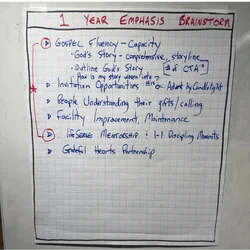
Here’s a snapshot from our recent Leadership Board & Staff Retreat—a raw look at the 1-Year Emphasis Brainstorm we created together just two days ago.

This list represents the themes our team is most passionate about pursuing in the next year. But a list alone isn’t enough. Now it’s time to bring focus and build momentum.

➡️ We could not decide between two high-priority areas. They both captured our team’s attention.

➡️ In this case, we need to combine them into one clear, compelling objective—and make it measurable. (We haven’t even done this yet!)
➡️ Then ask:

“If we want to accomplish this by year’s end… what’s most important right now?”

Brainstorm freely. Make a long list.
Then consolidate and choose your top 4 action initiatives to tackle in the next 90 days.

Small Bursts. Long-Term Fruit.

It might not feel flashy.
But make no mistake, 90-day focus is what transforms a vivid dream into a movement that actually changes lives.

Jesus didn’t rush His mission. But He was relentlessly focused.

You can be too.
Vision isn’t accomplished all at once.
It grows 90 days at a time, in harmony with the rhythms God built into creation.

Reflect & Respond
  • What’s one thing we could do in the next 90 days to move toward our milestone?
  • How will we define “done” for that task?
  • Who will lead it?
  • How will we celebrate when it’s accomplished?

If your team can answer those four questions, you’re further along than most churches.

Ready to Plan Your Next 90 Days?

This is the final step in the best vision clarity process for churches, but it’s also the beginning of a new way to lead.

I help churches implement 90-day action rhythms that lead to sustainable clarity, health, and impact.

📅 Schedule a free Vision Discovery Call here

Want the deeper “why” behind this process?

Check out our featured series: From the Head of the Church: A Vision-Shaped People

It reminds us that clarity isn’t the goal—Christ is. And when we follow Him, we become a people shaped by His vision.


Tags : Vision Clarity Pillars Share This :

Facebook-f


Twitter


Tiktok


Linkedin-in


Instagram

Related Post

What Happens When a Church Gets Clear? A Final Word on the Best Vision Clarity Process for Churches

What Happens When a Church Gets Clear? A Final Word on the Best Vision Clarity Process for Churches

April 7, 2026

What Happens When a Church Gets Clear? A Final Word on the Best Vision Clarity Process for Churches

What if your church could move forward with unity, clarity, and joy—knowing where it’s headed and why?

That’s exactly what the best vision clarity process for churches is designed to do. Over the past few posts, we’ve broken down a Spirit-led, stakeholder-owned approach that leads to real alignment and sustainable momentum.

Let’s quickly revisit the journey, and if you missed any step along the way, now’s your chance to catch up.

1- Name the Horizon

Vision isn’t just about dreaming big; it’s about describing the future God is calling your church into. In From Fog to Focus: How to Name the Vision Your Church Is Called Toward, we walk through how to define your “Mountaintop” and the “Milestones” that make progress visible.
→ Clear vision helps everyone see where you’re going and why it matters.

2- Listen First

You’re not Moses. Vision isn’t meant to be delivered from on high—it’s discovered through the voices of your people. In You’re Not Moses: Why the Best Vision Clarity Process Starts with Listening, we emphasize the power of deep listening to key stakeholders, longtime members, new voices, and the Spirit’s activity.
→ Shared discovery leads to shared ownership.

3- Build Strategic Focus

Vision without direction leads to frustration. That’s why Strategic Focus Is the Game-Changer is Step 3. You’ll define 3–4 initiatives to work on over the next three years. And a bold, measurable 1-year milestone.
→ Focus creates energy. It prevents burnout and sparks participation.

4- Take 90-Day Action

As we saw in Why 90 Days Changes Everything, long-range goals become reality through consistent short-term action. Break your 1-year milestone into quarterly sprints. Assign ownership. Measure. Celebrate. Adjust.
→ Short-term action leads to long-term fruit.

This Isn’t Just a Planning Tool. It’s a Pathway to Impact.

At its core, the best vision clarity process for churches isn’t about creating a static plan; it’s about aligning your people with God’s direction. It’s about unlocking purpose, deepening joy, and stewarding the season your church is in with courage and clarity.

It’s the kind of process that invites everyone to play—staff, elders, volunteers, households, and everyday followers of Jesus. When that happens?
Church isn’t just a place people go.
It becomes a movement people are part of.

Want Help Leading This Process?

You don’t have to figure it all out alone. If you’re ready to lead your church through a Spirit-led, stakeholder-owned clarity journey, I’d be honored to guide you.

Schedule a Vision Discovery Call or DM me today. Let’s start the conversation.

Want the deeper “why” behind this process?

Check out our featured series: From the Head of the Church: A Vision-Shaped People
It reminds us that clarity isn’t the goal—Christ is. And when we follow Him, we become a people shaped by His vision.

Tags : Vision Clarity Pillars Share This :

Facebook-f


Twitter


Tiktok


Linkedin-in


Instagram

Related Post